

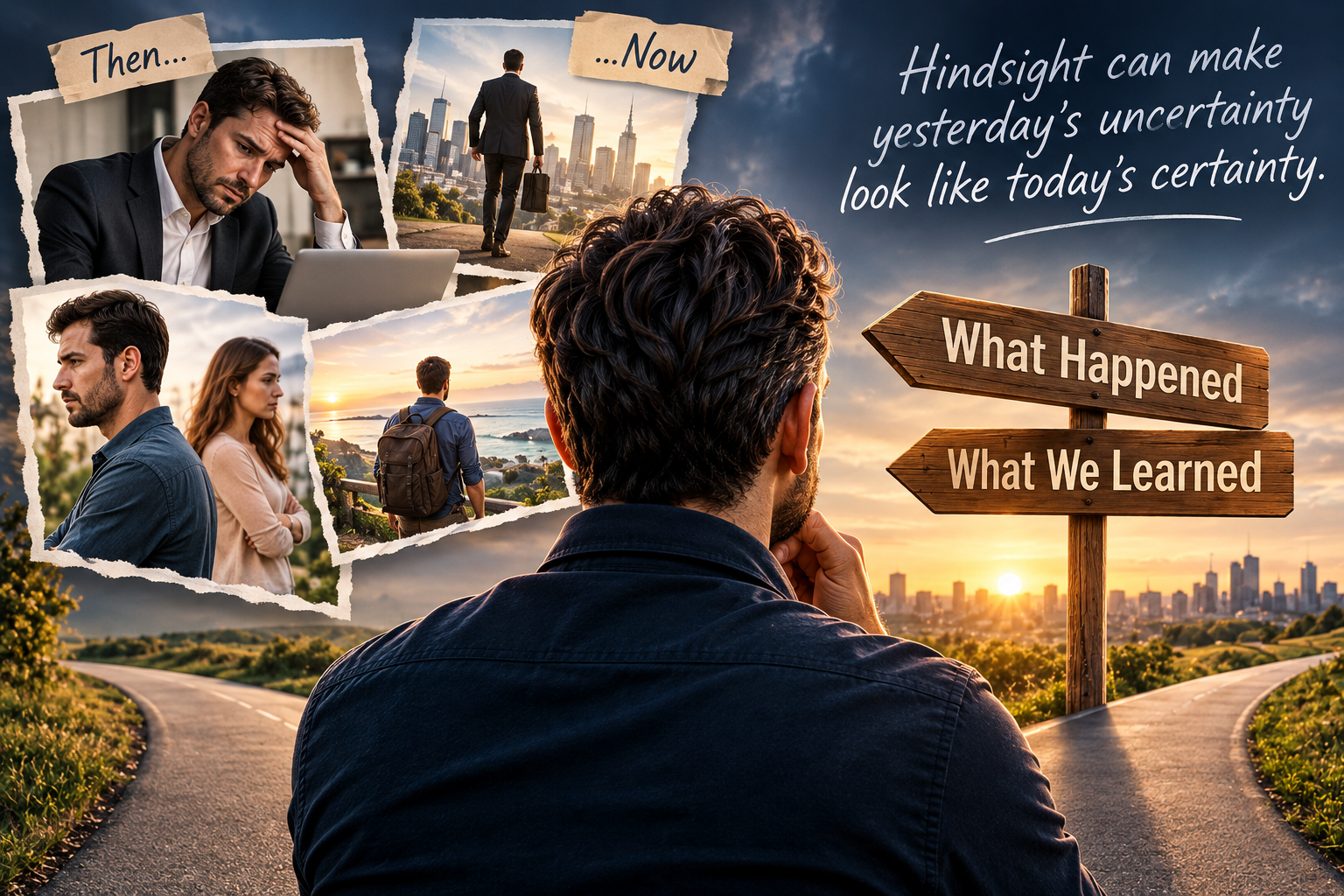
We often believe that the hardest part of making a decision is choosing what to do. Yet something interesting happens once the consequences become clear: we begin to remember the decision differently. What once involved uncertainty, hesitation, and competing possibilities gradually becomes a story in which the outcome seems almost inevitable.
We forget how little we knew at the time. We remember the details that support what happened and overlook those that might challenge our interpretation. Eventually, we can become so convinced by our own version of events that we struggle to distinguish what we actually knew from what we learned afterward.
Psychologists call one aspect of this tendency hindsight bias, the inclination to perceive an event as having been more predictable after it has occurred. In other words, once we know how a story ends, we tend to believe we could have seen it coming.
Consider a business owner who invests in a new venture. The investment fails, and people begin pointing to the warning signs that were supposedly obvious from the beginning. Another business owner makes a similar investment, succeeds, and is praised for having exceptional judgment. Yet both may have faced comparable uncertainty, worked with similar information, and accepted similar risks.
What changed was the outcome. The quality of their original judgment may not have been so different.
This distinction matters because we have a tendency to evaluate decisions by what they produce rather than by how they were made. Success becomes proof of intelligence, while failure is treated as evidence of poor judgment. We rarely give enough consideration to the circumstances, information, and limitations that existed before the outcome was known.
A good decision can lead to a disappointing result. A poor decision can produce an unexpected success. Someone can carefully assess a situation, consider the available alternatives, and still encounter circumstances beyond their control. Another person can take an unnecessary risk and benefit from being in the right place at the right time.
If we judge both exclusively by their results, we confuse good judgment with good fortune.
The same distortion follows us into our personal lives. We look back at relationships that ended, opportunities we declined, or paths we chose and begin to question what we should have done differently. Sometimes that reflection is valuable. Other times, we judge our former selves using information we simply did not possess.
A relationship that eventually became unhealthy may have once been a source of genuine happiness. An opportunity that looks extraordinary today may have carried risks that were difficult to recognize at the time. The fact that we understand something now does not mean we could have understood it then.
This does not mean we should excuse every mistake or avoid taking responsibility. There is a difference between acknowledging that circumstances were uncertain and refusing to learn from our decisions. Reflection becomes useful when it helps us understand what we overlooked, where our reasoning was weak, and what we might approach differently in the future.
A more honest way to examine a past decision is to return to the moment in which it was made. What information did we have? What alternatives were realistically available? Which risks did we recognize? What could we reasonably have anticipated, and what only became apparent afterward?
These questions allow us to evaluate our judgment without rewriting history.
They also have implications for the decisions we make today. We often delay choosing because we want greater certainty, believing that enough analysis will eventually reveal the safest path. But complete certainty is rarely available. Important decisions are made with incomplete information, competing priorities, and consequences that cannot be fully predicted.
Maturity in decision-making is not about eliminating uncertainty. It is about learning to assess it, recognize our limitations, and make the most considered choice possible with the information available.
We should be willing to question our decisions, but we should also be careful about the standards by which we judge them. Our past deserves examination, not distortion. We can accept responsibility for mistakes without pretending that every outcome was foreseeable.
Perhaps the fairest question to ask ourselves when looking back is not simply whether things worked out, but whether we made the best judgment we could with what we knew at the time.
We cannot change what happened, but we can change what we learn from it. And sometimes, that begins by remembering the decision as it really was, not as the outcome has taught us to remember it.