
Thousands of miles from Lebanon, there are places where the country does not feel far away at all. They are found in Maronite churches, where Mass, language, food, music, and family traditions have become something larger than individual memories. For generations, these parishes have done more than serve their congregations. They have given Lebanon a place to live abroad.
You can carry photographs, recipes, flags and stories across continents, but you cannot pack the feeling of home into a suitcase. And yet, on a festival afternoon at a Maronite parish in the United States, that feeling can return with startling force.
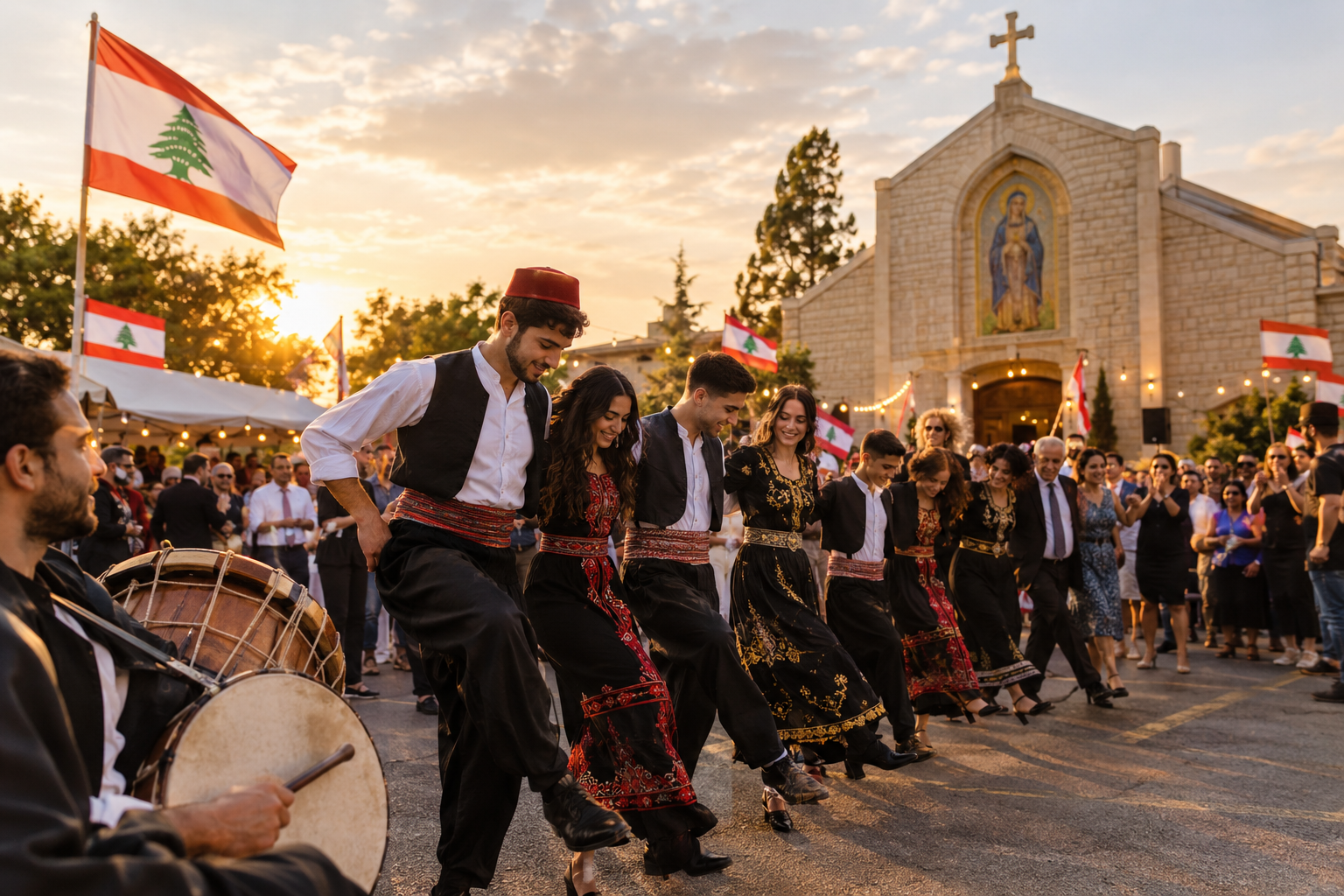
Charcoal smoke drifts across the parking lot. Cardamom coffee mingles with grilled meat and the smell of man’ouchet zaatar. Inside, women carry trays down the hall while an older woman insists, as she does every year, that the tabbouleh needs more lemon juice. Outside, children run beneath Lebanese flags as a derbakeh begins to fill the air.
Then a mouwwel rises from the speakers.
Conversations pause. Older men smile. Someone starts to clap, and before long a dabke line forms. Maronite, Melkite, Orthodox, Sunni, Shi’a and Druze stand shoulder to shoulder, hands joined, feet finding a rhythm they somehow already know.
For a few minutes, the distance between Lebanon and the United States seems to disappear.
I have lived in the United States for ten years, and I have come to understand that moments like this do not happen by accident. They are built patiently, over generations. In the diaspora, the Maronite Church is one of the places where they are built.
In Lebanon, identity is nearly invisible because it surrounds you. It lives in the Lebanese dialect you speak without thinking, the coffee offered before you ask, the bells carried across the valleys, and the traditions passed from grandparents to grandchildren. You do not have to work to preserve what surrounds you. Then you leave, and everything changes. Culture no longer surrounds you. You must choose it.
This is where the Maronite Church stands apart. Long before Lebanon became a modern state, the Church helped preserve a Lebanese Christian identity through monasteries, villages, and communities that endured generations of hardship. Its liturgy carries a Syriac tradition rooted in the ancient language of the region, preserved in the Mass’s most sacred moments. When Lebanese families left for new shores, they carried that faith with them, and wherever they settled, a church was often among the first things they built.
That is no coincidence. Faith gives the parish its permanence. Baptisms, weddings, First Communions, and funerals are held here, in rites known to generations before us. People come for Mass, and in coming, they find one another. The festival is an extension of that community. Its joy grows from something deeper: a shared faith that has given people a reason to gather in the first place.
For many Lebanese abroad, this is simply “the Lebanese church.” Its foundation is unmistakably Maronite, yet its doors open wide. Melkite and Orthodox families worship alongside Maronites. At festivals, Sunni, Shi’a, and Druze families come through the gates as well.
The church does not surrender its identity to create belonging. Its roots are what allow others to feel at home. For an afternoon, Lebanon’s complicated history steps aside, and people share what came before the arguments: food, music, hospitality, and memory.
That matters most for children born far from Lebanon. Without something tangible, memory can become only a story. The parish turns it into something a child can touch.
So the parish teaches Arabic. Children learn dabke. Youth groups gather. A girl learning Arabic is learning how her grandmother thinks, jokes, and shows love. A boy learning dabke discovers that heritage lives in the body. When the drum begins and his feet find the beat, Lebanon is no longer distant.
None of this happens by itself. Mothers spend days in the parish kitchen. Volunteers give their weekends, set up tables, teach lessons, and sweep the church hall at midnight. People keep showing up, year after year.
That is how a culture survives abroad: not through nostalgia, but through people willing to give it a home.
Ten years away have taught me that home is a feeling of recognition. A Lebanese accent in a crowded room. A dish that takes you back. A mouwwel that suddenly brings you closer. For a moment, the distance disappears.
That is the Maronite Church’s gift to the diaspora. It does not keep Lebanon as something behind us. It gives Lebanon a place to be heard, tasted, danced, prayed, and handed to the next generation.
Wherever that happens, Lebanon is not merely remembered.
It is alive.